Intro
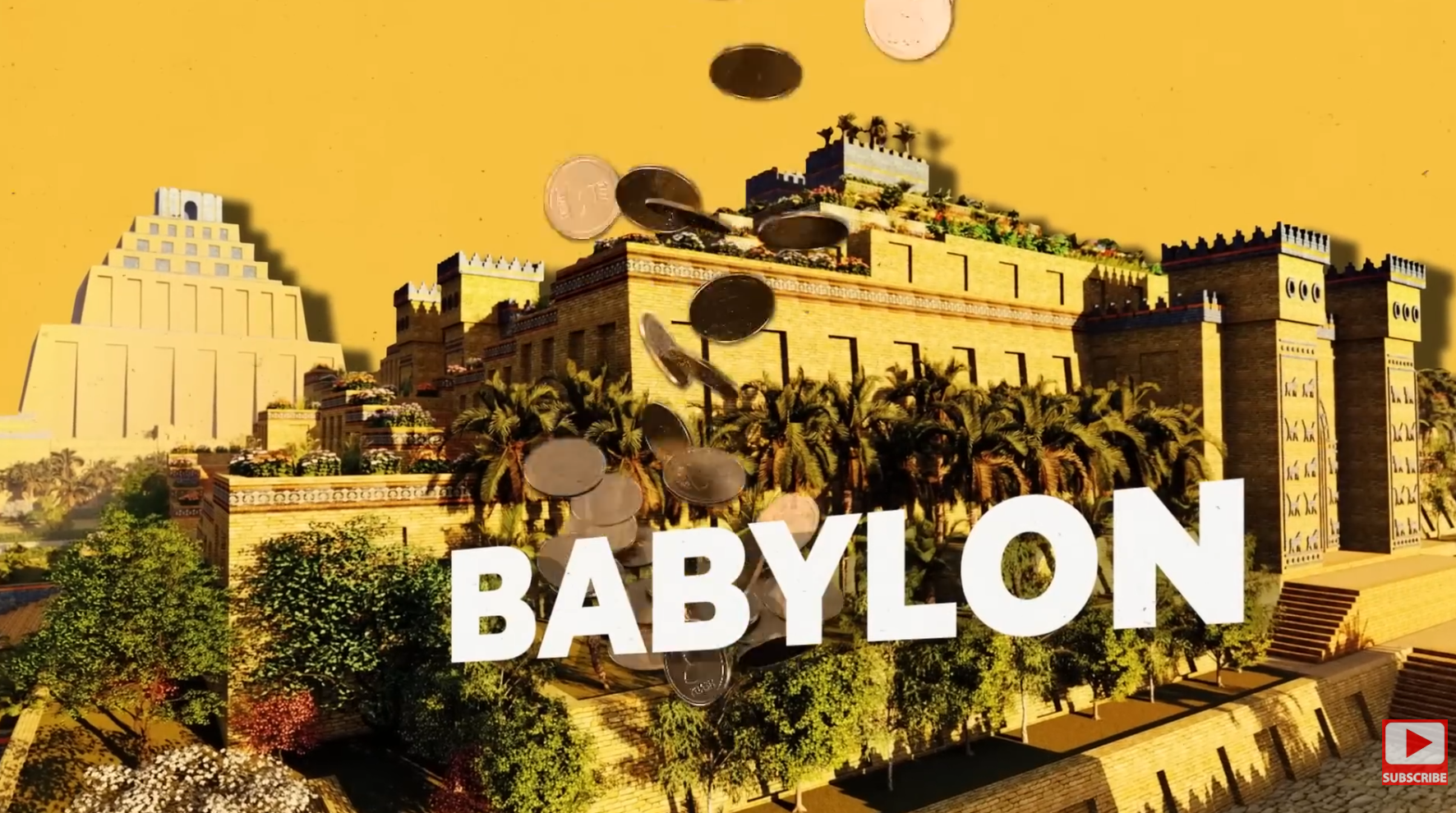
The city of Babylon was the richest city in the world and a center of power for over 400 years. Even though it was one of the most influential cities in history, it managed to crumble to dust thanks to constant conquering forces and one king who let his pride get the best of them.
The Beginning
The true beginning of the city of Babylon is unclear. We know that it began in 2300 BC in ancient Mesopotamia. What remains of it today resides 50 miles south of Baghdad, Iraq.
For instance, archaeological evidence would suggest that Babylon was a walled settlement near the Euphrates River. Fertile land and easy access to water allowed it to thrive to the point that it could slowly begin to expand.
Its position on the Euphrates made it a prime location for controlling international trade in the area. This gave it the necessary wealth and power to slowly grow into the city we see the sad ruins of.
The greatest achievements of this empire were true benchmarks in the rise of human society. The rule of law was codified and preserved in rock with the Code of Hammurabi. This is one of the greatest sets of laws ever brought forth in the ancient world.
It was a place of advancement in the fields of mathematics, medicine, astronomy, and so much more. As far as daily life was concerned, people typically lived in three-story buildings with rooftop patios that offered them cool breezes from the heat, where they drank beer, slept, and relaxed from a hard day’s labor.
It was the single richest city in the ancient world until one king pretty much ruined it for everybody.
The Final King
The final failure of Babylon all came down to the rise of its last king, Nebonitus.
The line of kings was quite a big deal in what’s known as the Neo-Babylonian Empire. That’s largely to do with the great King Nebuchadnezzar II. He was a great conqueror known for going to war with Egypt and was responsible for the destruction of Jerusalem.
He was a villain by biblical history, but one of Babylon’s greatest heroes. He also brought forth an age of growth. His reign saw massive advancements in astronomy, arts, culture, and science, not to mention the work he did revitalizing the city of Babylon, including rebuilding the Ishtar Gate, which is one of the most influential building projects in history.
He was also responsible for the Hanging Gardens of Babylon, the tiered artificial garden made of dozens of different kinds of trees, flowers, and other plants as a gift to his own wife. It was considered to be one of the wonders of the ancient world.
So breaking this line was considered to be a big deal, and the first big way that Nebonitis sealed his own fate.
The new king, Nabanatus, had quite the legacy to contend with, and he really failed to do so, as you’ll see. Nabanatus sealed his own fate not once, not twice, but three times.
The Fall of Babylon: Military Might
The fall of Babylon came from perhaps the least epic battle in the ancient world. The Persian Empire, led by Cyrus the Great, by all accounts practically waltzed into the city with little resistance.
This is a far cry from the glory days of the city. It was once considered a fearsome city that made many military advancements that allowed it to stay in power for so long.
That society not only created incredible defensive structures that have even still held up against time itself, but pushed forward siege tactics, cavalries, and the training of professional soldiers.
The Battle of Carcamesh against ancient Egypt is one of the most important conflicts in ancient history. It paved the way for Babylon gaining the influence it would be known for.
Once again, this fall from grace was due to the ineptitude of the city’s final king. It seems as though Nebonitus was in no way a strategic genius.
In fact, he left the defense of the kingdom to his crown prince, Belshazzar, while he himself focused more on religious duties that you’ll see in a minute were also wildly unpopular.
The prince may have been a capable soldier in his own right, but the king’s lack of interest in the defense of his own kingdom made him extremely unpopular when it came to his own soldiers and military advisers.
And so King Nebonitus sealed his own fate for the second time.
The Sin of the King
Perhaps the greatest mistake of King Nebonadus was his rejection of Babylonian religion.
The cult of the god-king Marduk was central not only to the founding of Babylon, but the actual creation of the world itself. Like the Greeks and Romans, the Mesopotamians had a vast pantheon of gods that formed their specific creation mythology called the Enuma Elish.
According to their history, the world was formed when the vengeful primordial goddess Tiamat battled the great god Marduk. Marduk was a young god who volunteers to fight Tiamat and her horde of monsters, but only if he is made the supreme deity.
Once he defeats Tiamat, he takes her body and uses it to create the sky and the earth. He then forges humanity itself and founds the great city of Babylon as his home. He even builds a temple in his own honor.
This just feeds into the legend of what Babylon was: a supreme city of military might, technological progress, and religious ecstasy. The citizens of Babylon literally believed that their city was forged by the greatest god-warrior that ever lived.
So imagine how happy they were when their king rejected Marduk completely.
King Nabanatus instead believed that the god of the moon, Sin, was the actual head of the pantheon. During his reign, Nebonitis raised the temples to what he believed to be the true god—an insult to Marduk and all those who believed in him.
And so Nebonitus sealed his fate a third time.
The Rise of Cyrus the Great
To be a little fair to King Nebonitus, the slow degradation of Babylon’s power wasn’t all his fault.
The true power of Babylon wasn’t really their advancements, their gods, or their rooftop parties. It was their location. The city was a hub of trade, and therefore a hub of power.
As time moved on, more civilizations began to spring up that offered better hubs of trade. Not only that, but they didn’t have to deal with the constant droughts and harsh weather of ancient Mesopotamia.
One of those empires was the Persian Empire, led by Cyrus the Great.
Yes, this is the time in history where rulers were hyping themselves up with titles like they were modern-day rappers or Guardians of the Galaxy.
Cyrus was the founder of the Persian Empire, and under his rule he conquered most of Western and Central Asia. While that makes him sound like some sort of monstrous warlord, be real—you’re picturing Xerxes from 300.
He was really well known for respecting the religious customs of the people he conquered.
Cyrus had engaged the empire in several massive conflicts, but the one that really decided it was the Battle of Opus, which is said to have allegedly featured the fall of military commander Belshazzar.
You know, the prince in charge of all the armies.
Of course, there are not incredibly clear pictures of what happened back in 539 BC, so when the massive Persian army reached Babylon, the city was practically handed over to him.
Cyrus then proved himself to be much wiser than Nebonitus was. The king was surrendered to Cyrus and, by some accounts, lost his life, but by others was sent away in exile.
Either way, it was considered to be a good riddance.
Cyrus then ingratiated himself to his new subjects by declaring himself to be a part of the line of kings, a savior of the cult of Marduk, and then rebuilt much of the city’s defenses and architecture in all ways possible.
The reign of Nebonitis was swept away, though that would not signal eternal peace in Babylon.
No, no. There were still rebellions to be had and another great ruler to call Babylon his own—one who was named Alexander.
Babylonian Rebellions
During the reign of Darius I, king of the Persian Empire, Babylonia revolted against the empire in 522 BC. This was common at the time of Darius I, who saw many revolts upon his rise to power.
They were briefly ruled by a man who declared himself to be Nebuchadnezzar III and the son of Nebonitis. His reign only lasted a few brief independent months before the Persian Empire retook Babylon in a much bloodier conflict that saw Nebuchadnezzar III executed.
Once Darius left the city, another revolt was held by a man declaring himself to be Nebuchadnezzar IV, who also just so happens to be the son of Nebonitus.
Nebuchadnezzar IV’s reign went to hell as well, with him getting crucified or possibly just impaled to stave off further rebellion—which seemed to work wonders.
It would take another empire to take control of the city from the Persian Empire for good.
Alexander the Great
331 BC saw the city fall against the Macedonian king, Alexander the Great.
While he seemed to have loved the city, his reign over it would see the age of Babylon truly come to an end.
In 323 BC, Alexander perished at the age of 32 in the palace once lived in by the great Nebuchadnezzar II.
This led to what’s known as the partition of Babylon. This was the dividing up of Alexander’s vast empire, which spanned about 2 million square miles from ancient Greece to Persia.
This led to a period of warfare over his empire, which turned the region into a battleground over foreign territory.
Babylon would never rise again from the conflict.
The empire saw great leaders like Nebuchadnezzar II, Cyrus the Great, and Alexander of Macedonia before finally crumbling to dust for good.
Outro
Judging from all the movies they’ve made about ancient Rome and ancient Greece, I think that Babylon’s been slept on by Hollywood. Do you agree?
I would love your support in the comments below. See ya.