Intro
The homes of the future are here, and they are magnificent. Even if you don’t have the millions of dollars it would require to purchase one, it’s very clear that the future is gonna have a lot of white color schemes and strange architectural shapes that incorporate landscapes. Just trust me on that one.
House Of The Future
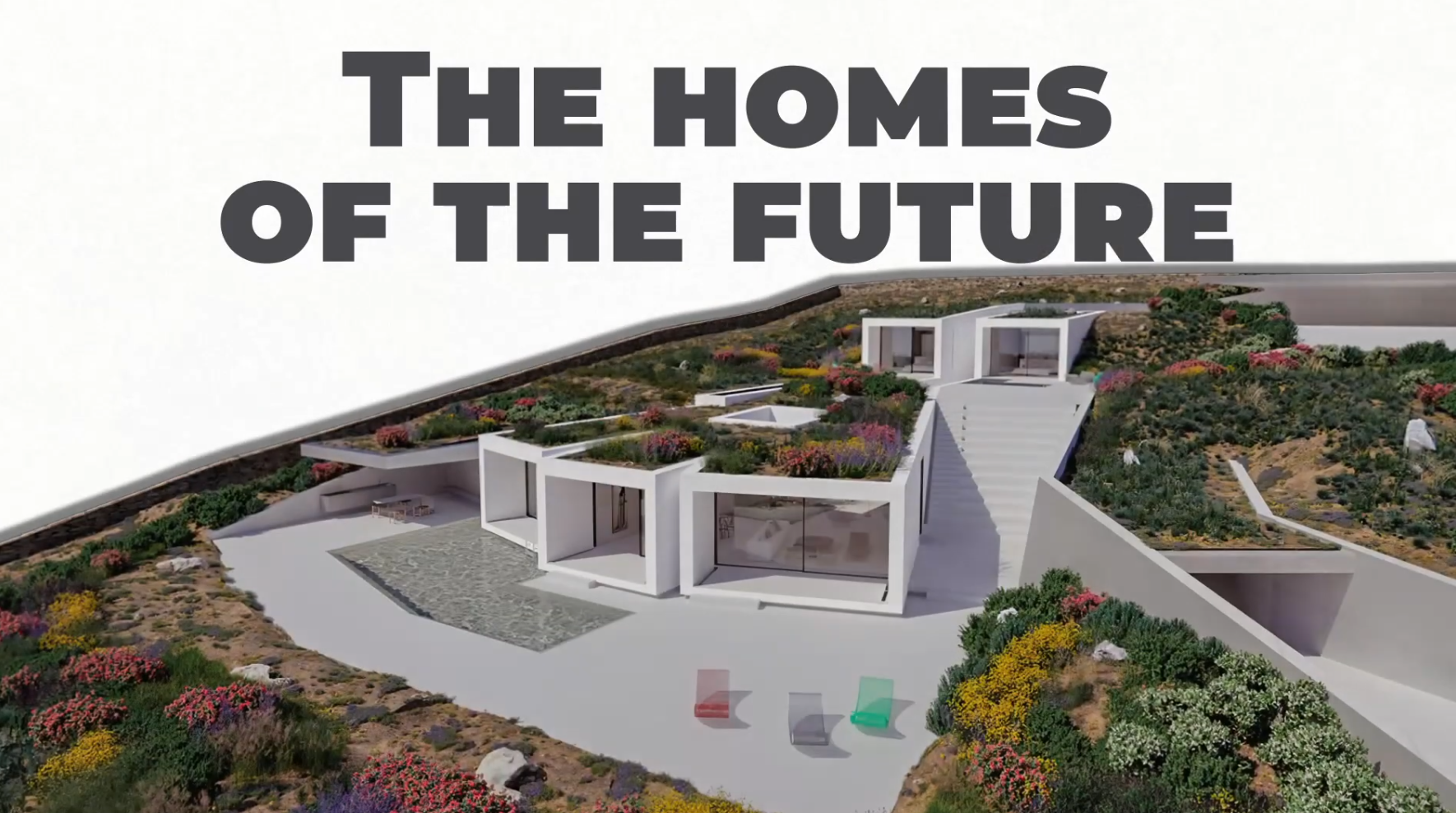
Star house in Marbella, Spain definitely fits this bill. You drive up to the place and actually park on what is basically the roof. They need to send it through the various living sections. Each one has a long white shape that appears to sink into the hillside itself. This makes it look like it merely sprang out of the ground one day fully formed and ready for renters.
The part of the home that really sells this idea the most to me is its unique pool. While it isn’t the biggest lap pool I’ve ever seen in a mansion, it appears to sink into the house itself. There’s almost the illusion that there’s a secret tunnel into the home that you can actually swim into. I mean I’m sure that’s a thing that can be arranged; you just have to talk to your contractor about it. I doubt it’s the weirdest request they’ve gotten.
The entire complex is spread out over a plot that runs 32 292 square feet. This Villa features four homes and four bathrooms. Each room is designed to feature big open spaces and as much natural light as possible. I mean you’ve got a house in Spain, why would you want light bulbs ruining that gorgeous sunlight?
Dom also has a great location. It is near the Mediterranean Sea. It has tranquil nature all around it. It’s also part of a private gated community with golf courses and high-end shopping options nearby.
So how does a place this cool run you? Well the Spanish home of the future, well the price tag of three million 302 599. Yeah, you could definitely get at least one secret tunnel for that kind of wave cash.
Wave
Even log cabins are in for a fancy redesign in the future. Look no further than wave. It is by far the fanciest of the new designs. The home is a new kind of wooden house built by Finnish manufacturing company polar Lifehouse with designs from acclaimed architect seppo montala. He is a frequent collaborator of theirs who is known for bringing modern design to rustic wooden homes.
Though of all of his many illustrious projects, wave is by far the best. It combines wood, glass, and steel into sharp angular designs that’s meant to be reminiscent of boats or airplanes. From the right angle, the entire home looks like a futuristic spaceship that can raise into the air and take off with a flip of a switch.
Interior redesigns the classic wooden home look as well. It looks like a unique combination of a log cabin, a vacation home, and a sauna. Expect to see a lot more homes that look like this one.
The house was shown at the annual finish housing fair in 2017. Wave one in three separate categories: the best house, the best interior, and the best garden.
The company is known for building interesting houses like this with an eco-friendly vibe. While many design firms are moving into this direction in the future, few are as successful at combining sleek modern styles with futuristic environmental sensibilities.
While the Amazon public with how much something like wave would cost, they have simpler prefab homes that go for over a million dollars. So expect the log cabin of the future to be in the tens of millions at least.
I mean it’s the wooden home equivalent of a three-time Oscar winner. Would you really expect a cheap price for the Nathaniel Day Lewis of log cabins?
High Desert House
If you really want to see a kind of futuristic home you never thought you would see, look no further than High Desert house. It is a home located in a unique place in a rocky terrain in Joshua Tree, California. This joins the trend of other homes that look to incorporate the beauty of the area into their designs, but few have done so quite like this one.
It’s rough sharp concrete angles are meant to be reminiscent of an animal’s rib cage. It almost seems like a fossil of a giant prehistoric animal that fell millions of years ago and someone simply made a home inside its skeletal remains.
The real story isn’t quite so dramatic as the tale goes. In 1986, famous Californian architect Kendrick bangs Kellogg received a very interesting letter. It turns out that a couple purchased this strange batch of land and gave the illustrious designer carte blanche on what he wanted with it.
The home was completed in five years, and another decade was spent perfecting the interior of the place. Inside, the home is arguably even more beautiful. It all incorporates the cave-like design with spiraling roofs that look like naturally occurring rock formations.
The sparse furniture and shadow cast natural lighting gives the entire place an intimate dramatic flair. I don’t know how this place hasn’t been featured in at least 15 movies and a few TV shows so far. This definitely needs to be fixed.
I don’t even know how you could possibly price this place. It’s not so much a home as it is a gorgeous work of art from one of America’s greatest unsung architectural artists. It may be truly priceless, or it could be just worth a few hundred mil to the right buyer.
Potato Chip House
Else to say there’s one of these quirky future designs that I think may have gone too far. This cliffside home in Granada, Spain is working way too hard to tell tell you that it’s a house right next to the ocean.
The idea behind this place was that it would be home that reminded the owner of summer all year round. The location is perfect for it, with a near constant temperature of around 67 degrees Fahrenheit.
The building itself curves up and down to emulate waves. The color scheme accentuates this too, with white sections that feature a series of small blue triangles which are supposed to represent waves on a white foaming ocean. Honestly though I think they do a much better job of emulating a potato chip. That’s just me though.
The blaze actually looks a lot cooler on the inside. It’s weird curving architecture and white on white color scheme makes it seem like the home is like a modern art museum.
It features three bedrooms and bathrooms spread out over 7804 square feet. That kind of design may have worked in the different environment, but I think this piece shows just how important topographical considerations to the other designs are.
The shape and color of this building absolutely clash against the mountainous terrain all around it. It also proved to be incredibly difficult to build on the plot. It is located on a 42 degree slope. That was a major challenge for the architects.
The entire process was labor intensive and required constant inventiveness to overcome challenge after challenge, bringing this dream to life.
So how much does the potato chip house run you? Well over 1.8 million dollars. This is what the future is like with that design at matte price. I think it might be all good.
Okay, okay.
Desert Star
For real, though, modern architecture has gone too far. This cuboid house looks kind of like what happens when the graphics on a video game start to glitch out.
The house is made up of giant rectangular shapes that kind of look like a bunch of cargo crates stacked to look like a bouquet. It looks like that because that’s exactly what it is. In fact, the home is constructed by joining 21 different shipping containers together, which is pretty ambitious for big giant shipping containers that usually are just asking to have graffiti all over them.
Okay, the design actually starts to look better when you give it a little space. The home goes by the name Starburst, and the home itself is shaped to resemble a star shining in the desert.
These storage units are brought together to form a luxury home with three bedrooms and a garage that has solar panels on the roof. It’s located in the scenic desert and Joshua Tree, California. But home is meant to be an eco-friendly desert oasis that brings the comfort along with the creativity.
Foam may feature rough shipping containers and 2 000 square feet of concrete flooring, but on the inside it’s all natural light and beautiful open spaces.
You can drop an offer on the shipping container Desert Star for the price of 3.5 million dollars.
Mars Case
So the big dream right now is that our boy Elon Musk will take the human race to Mars and populate the planet. While this sci-fi concept sounds really cool, it would actually be incredibly difficult and uncomfortable.
Yeah. Yeah. I wish it wasn’t so hard. Just ask Matt Damon.
Enter beijing-based company open architecture, which is working on a project they call Mars case: a housing prototype designed to be the ideal human environment for the harsh red planet.
Think less a luxury apartment and the stars and more a futuristic tiny house. It looks like a little white bubble with a square attachment on the back.
Inside, you’ve got everything you need, well except space. The interior looks like an Apple store with bright white everywhere.
It’s a 2.4 meter by 2.4 meter by 2 meter module that’s designed to be like a suitcase with foldable sections to make it easier to store. Each amenity from the bathroom to the furniture can be stored into the wall to conserve space.
I imagine after walking around in a spacesuit all day, even a place like this can feel like home. While it doesn’t look like the comfiest place to live, its design is perfect for the rough environment.
The home is designed to conserve everything. That includes energy, air, and water. That’s all diverted back into an integrated ecosystem to save resources.
They claim that the home is designed to push forward the lifestyle that will be needed for the new martians. There’s no room for waste or consumerism anywhere, just what is necessary to survive.
So pretty much everyone on Mars is gonna have to live like a freaking Jedi. No attachments allowed.
Previously, it’s been reported that building a colony on Mars would be the single biggest construction project ever taken on. The budget was given 10 trillion dollars. That is about 1 8 of the entire world’s economy.
Mars case is designed to be a cheaper prefab home that could cut down on that cost drastically. There’s no word on exactly how much this prototype costs to build, but as long as it’s under a trillion, it’s a steal.
So it’s good to know that the first thing we’re going to do on a new planet is start building cramped studio apartments. No wonder Elon moved into a tiny house for him to prepare for his dream of a Mars retirement home.
It doesn’t look that great, to be honest. A lot of these future—
Villa Allegra
Homes like to incorporate the topography of the setting in the design, but none of them go quite as far as Villa Allegra. I mean it is so sunken into this hillside, guys, that it almost looks like a bond villains lair that’s trying to keep itself secret.
All it needs is a little red button that would make the whole structure to send a few feet before it’s completely sunken from you.
Officially, it’s called a subterranean low-level house that’s built into slope. It features four bedrooms and six bathrooms on a four thousand fifty six square feet clocked.
The subterranean nature of the home isn’t just for a unique style, but also to shelter the property from harsh winds of the environment.
Of course, when you’re building a house in Mykonos, Greece it’s understandable that you’d want to incorporate as much of the land as humanly possible.
Even if the winds can be rough, it is one of the most stunning locales in all of the world. Property is a short distance away from delos Island and the Aegean Sea.
The building of the home represents the push towards crafting places that do less to disturb the natural ecosystem. Why design over something that’s already gorgeous?
Even if it does look like the kind of mansion Bilbo Baggins would buy.
While the exterior pushes a new style, the interior is pretty much what you’d expect from modern homes: blinding white color in all directions, open spaces, and of course a ton of natural light.
I was kind of hoping that the future would have a more interesting color palette. Clearly we’re going to be stuck with the Apple store by for at least a few more decades.
So how much is this Bond villain Hobbit Hole? 4.8 million dollars. Another million and it would probably feature my red button idea. Patent pending.
Dolomite Blick
Most apartment buildings in the present are ugly concrete square buildings that could probably use another coat of paint. Well that looks like it may be a lot better in the future.
Just take a look at Dolomite and Blick, the apartment complex of the future. It’s a truly bizarre looking space that kind of looks like two houses of cards falling into each other, you know, in a cool way.
It’s roughly angled shape is supposed to be inspired by the mountains plains all around it. This leads to a cool feeling where it almost feels like your walking into a cave or a tunnel when you approach the building’s front door.
This is definitely the kind of apartment Batman would choose. Can’t you just see the Batmobile flying through that front door?
This wild design was put together by plasma Studio. They are well known for their pitch that the architecture of the future should feature a ton of sharp rigid angles.
Their mission statement is to fold space into space by utilizing the landscapes into the design. I don’t exactly know what that means, but it sounds pretty good.
Now the apartment complex in question is still my favorite of their works. The building’s bold angular shape not only looks good from the outside, but it’s cool from the inside as well.
It’s designed into different sections whose eye lines don’t match up so you can’t possibly get a peek into your neighbor’s room. Yeah, this is seeming more and more like a place Batman would love.
Man is all about practicing construction on the the place cost millions and was finally completed in 2012.
Not only is it a successful apartment complex, but it is known far and wide as one of the best examples of modern topographical design.
This is basically the trend that we’re seeing more and more of where the buildings themselves look less like man-made objects and more like they’re part of nature itself. It’s been featured in magazines and websites and may be featured in a future near you if its popularity continues.
Okay, so these homes are just ideas, really. Think of them as rough drafts that aren’t entirely completed yet.
Aerial Web Homes
That being said, I just had to show you, though, because the aerial web homes completely revolutionize the very concept of what a home could be. Whether that’s a good thing or not is up for you to decide.
You see, they are homes that are actually lifted into the skyline and hang hundreds of feet into the here. Imagine a futuristic city with man-made spider web homes stretching through the skies. That’s the future these homes are proposing.
The whole thing is actually a design project from a student named huangai Tao from the Texas A M University College of architecture. It was designed to solve a critical space problem that only grows every year due to increasing overpopulation and increasing lack of suitable housing.
The look of these strange homes are reportedly based on two things. The first is cellular structure and how it moves in a subatomic environment. The next are data streams as they appear in films such as the Matrix.
Though he’s obviously cutting my boy Spider-Man’s contributions to the design out entirely. Now you know how the Winkle bus twins felt. Spidey, you got Zuckerberg. Happens to the best of us.
Inside the web homes are interconnected sections that include bedrooms and bathrooms on the higher levels and amenities like an indoor swimming pool at the bottom.
Now I know what you’re thinking: how would anyone get in this house? Well that’s actually a really, really good question.
I’m not exactly sure if these homes are expected to descend to the ground for homeowners to enter, if there’s some kind of railway system that travels across the lines that hold the floating homes in place, or if this is just the kind of future where flying cars are considered the norm and a future where humanity has gotten rid of its fear of heights all together.
As far as prices go, I would expect the strange nature of these tiny homes would blow up the price. It wouldn’t surprise me if your urban spider web would cost tens if not hundreds of millions.
I think there’s a good chance the insurance would cost about as much I can even imagine.
Oh, I need to do is get a few hundred bill and my future retirement can feature a webbed sky apartment, a spaceship log cabin, and a craft Mars vacation home.
That is a plan.