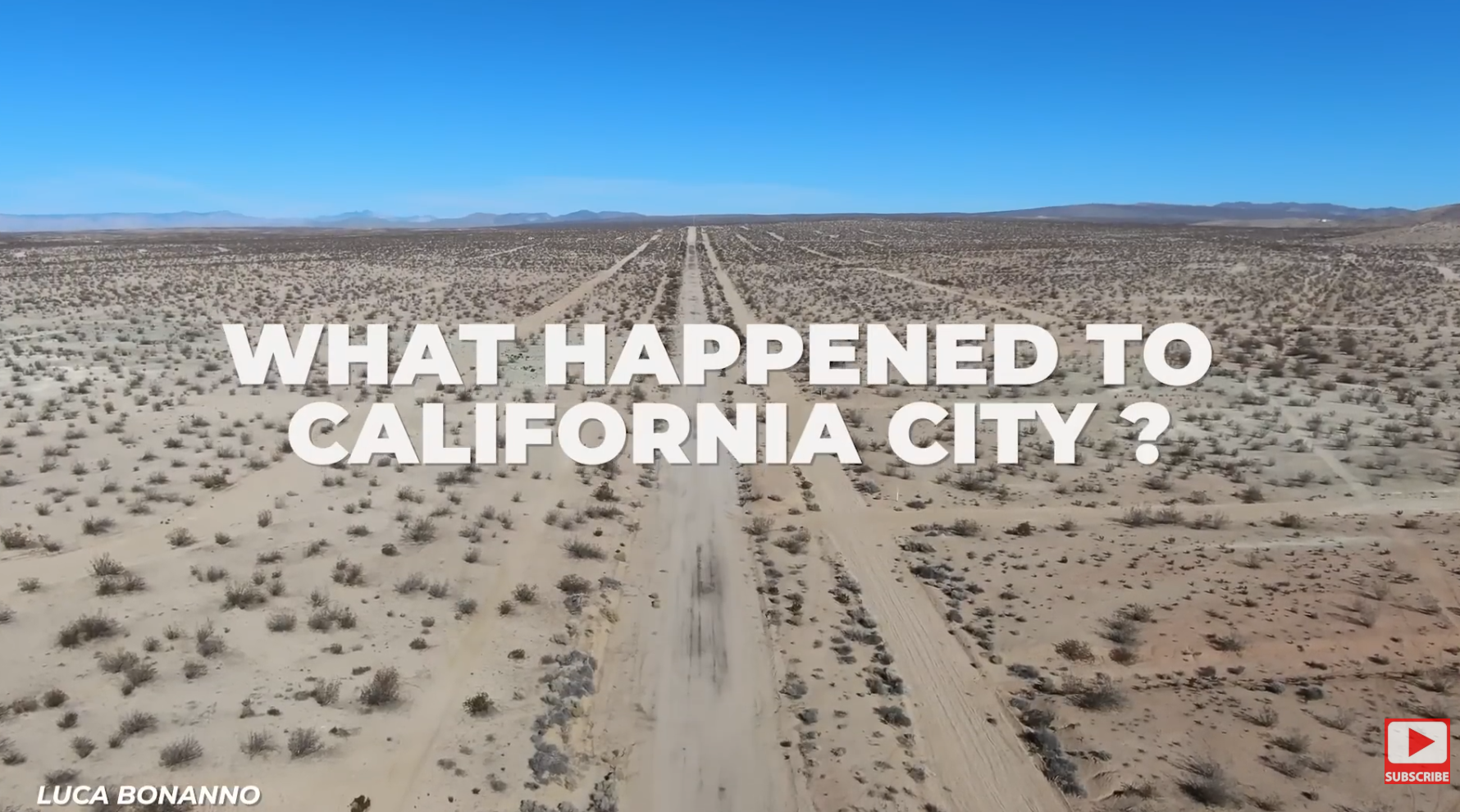
In the 1950s, California City was envisioned to be the New York of the West Coast, dwarfing even L.A. and San Francisco. Today, it’s basically a ghost town. So what happened?
California City: The Dream
California City represented a very 1950s Americana sort of dream, a dream that would end up costing well over 200 million dollars. It was supposed to revolutionize the very concept of the city for post-war America.
The city was supposed to be the perfect blend of suburban life and urban life—a big city with a small-town sensibility. It was constructed as a haven for families and businesses alike, an idea that was incredibly popular at the time.
There were even plans to create neighborhoods built for specific purposes. Hubs would exist for medicine, industry, commerce, and academia. This was to be a city of progress without sacrificing small-town ideology.
All of this was exemplified in the central park of the city, a lush patch of greenery in the middle of the Mojave Desert. In its center was a lake which was literally filled with tens of gallons of water flown all the way from the Central Park in New York City.
In many ways, New York City was the inspiration for California City, so maybe they thought this water would be a good luck charm. I wouldn’t say it worked, because this promise of an urban oasis turned out to be nothing but a mirage.
If the city existed today, it would certainly be a unique metropolis: less residential areas juxtaposed against huge skyscrapers, and a street system designed to make traffic as efficient as possible.
Had this city proven to be the success its founder hoped it would be, there’s a very good chance that it would have become Silicon Valley instead of Palo Alto. Either that, or it would have become the tourist spot in California. Who knows? It may have even had its own Disney park.
Ah, what could have been.
The Reality
What does California City look like today? It’s actually become infamous as one of the greatest abandoned cities in the United States. The city has become a sparsely populated ghost town.
Sure, it has some charming houses, a few churches, a few schools, a post office, a police station, and a McDonald’s, but there’s a lot of empty space and vacant desert in between these locales.
While this town certainly has its charms, and there are no doubt plenty of happy residents there, there’s no denying that it utterly failed to achieve all of its goals.
The population was supposed to overcome that of Los Angeles. Today, L.A. boasts over 12 million people. Cal City, on the other hand, has only around 14,000 people, so not even close.
In fact, the city not only hasn’t proven to be a utopia, but has actually had negative effects on the environment. 2014 saw the state of California enter into an intense drought. The outdated plumbing infrastructure of California City did little to help this problem.
The city was even named one of the state’s worst water wasters. That’s pretty impressive considering the relatively small size of the city.
While things will likely never match the dream so many people were sold on, there is hope for California City to thrive in the future. Cal City is now looking to hedge all of its remaining bets on the cannabis industry. The town has approved massive expansions to the booming businesses.
Today, it seems like history may be repeating itself. The city is rebranding itself for the green future, trying once again to get people to buy land in the desert. Only this time, they are replacing a ’50s suburban dream with a 420-friendly paradise.
Time will tell if this strategy will pay off.
The Builder
Behind every failed utopia is a visionary turned cautionary tale who convinced people to invest big money into their dream. This visionary was the Czech-born sociologist turned professor Nathan Mendelson.
Mendelssohn was fascinated by the nature of cities. He studied various towns and villages, searching for the secrets to a better society through their successes and failures. He immigrated to New York and, according to his daughter, was widely inspired by the close-knit communities that he found there.
In the late 1950s, there was a post-war development boom that Mendelssohn capitalized on big time. He purchased 82,000 acres of land in the Mojave Desert with dreams of making it into California City, the next great American metropolis.
Funnily enough, he got really, really good at selling this dream. Magazine ads, commercial jingles, and word of mouth all led to Americans investing heavily into what they called a good and safe investment.
In the early ’60s, development heated up. They built the beginnings of a town, including the essentials like a post office, residences, hotels, and a park. Of course, they also constructed two golf courses, probably to juice up their ads. It’s really hard to entice people with the promise of the American Dream if there’s not at least two golf courses.
They even named streets after prestigious colleges in the U.S. like Stanford, Rutgers, Yale, and Columbia.
The sales force for this city was nothing less than an army. The California City Development Company, or CCDC, ran what they called a real estate school. Here, they trained hundreds of workers and techniques to potential buyers who weren’t used to such aggressive tactics.
In fact, the longest-lasting legacy for the California City project was probably the aggressive sales techniques the city successfully employed. It showed that it really didn’t matter if you could back a dream up or not—people would pay through the nose just for a chance to believe it.
It seems like Middleton’s sales force bordered on a cult-like devotion to his California dreams. In fact, a former saleswoman who used to work with him confessed that she thought he got his dream of Cal City as some sort of vision.
What’s funny is, in that same interview, she admitted to having to fire 75 people in one day at his office. Despite such failures and controversies, she still thinks California City is destined to be. It’s a dream that’s always around the corner but never truly arrives.
This trend has continued even through today, with infomercials selling parcels of land there starring Erik Estrada himself.
By the mid ’60s, they had 5,900 landowners invested into this fantasy. The problem was that they had only 232 homes and 817 additional residential properties built altogether.
It was said in the inevitable court case that 200 million dollars was brought in for the development. It doesn’t take a genius to figure out the math on this one.
By the early ’70s, the government started to crack down on this ad campaign because it wasn’t informing people of the risks to purchasing empty lots in the middle of the freaking desert.
The lawsuits and the widespread accusations of fraud led to a ton of refunded money—refunds to the tune of over 2.3 million dollars. The dream was never able to weather this storm of controversy. It never came close to becoming the utopia Mendelson envisioned, no matter how many salespeople would say otherwise.
Outro
California City is far from the smallest in the state, though. The charming community of Carmel-by-the-Sea has a population of less than 4,000 people.